Showing posts with label Serial drama. Show all posts

Monday, September 09, 2013

The author an endangered species?


Having referred back to the Middle Ages in my most recent post in the series tagged Serial drama, the passage below caught my eye this morning.

"The medieval theatre audience was an active part of any performance, supporting certain characters, opposing others, and voicing their opinions and preferences loudly and clearly... at times even throwing food at the actors. Similar behaviour is still apparent in, for instance, the Japanese Kabuki theatre, where actors can step out of their roles and interact with the audience, who get to respond."

The full article is here and in it Simon Staffans argues that the author is an endangered species if he insists on ignoring transmedia and interactivity.

Wednesday, September 04, 2013

Serial drama


Back on my hobby-horse once more... post-network serial drama... and I am tagging these blog entries for those wishing to follow me in this exploration.

Offline conversations have seen me obliged to defend my bias towards 'fast turnaround production' of video fiction. "How can a weekly output of 115 minutes of television storytelling in any way be compared with a two-hour motion picture crafted after six months of shooting?" 

It is a question I had to answer quite often when I was producing soap opera in the nineties, sometimes posed by affronted cinéastes, more often by actors worried that signing up for a soap could somehow be detrimental to their reputation.

My response was based on my reading of an aspect of the history of the arts and entertainment, harking back to the time of the troubadours, mummers, guisers and such. 

From the commedia dell' arte of the fifteenth century to the twenty-first century soap opera is not such a big jump. The characters represented fixed social types, stock characters, such as foolish old men, devious servants, or military officers full of false bravado. Characters such as Pantalone, the miserly Venetian merchant; Dottore Gratiano, the pedant from Bologna; or Arlecchino, the mischievous servant from Bergamo, began as satires on Italian types and then became the archetypes of many of the favorite figures of later European theatre.  

Does soap opera not rely on archetypes, with every ensemble of fictional characters required to have the standard complement of types? The underdog... the super villain... the girl next door... the rebel...  the straight-laced 'good guy'... the 'bad girl'... the matriarch.

More important... history speaks of this form of entertainment as being above all for the people, for those crowding the market square, going about their daily business but welcoming the divertissement provided by the travelling jugglers, acrobats and players.  

However the town had not only a market square but also an imposing castle, the preserve of the formally educated, the sophisticated refined, the powerful. And among them are the patrons of the higher entertainment arts. Performances at court may be of the works of playwrights, composers, librettists, choreographers... of creative artists whose names remain revered in the chronicles of European culture.

I would argue that with soap opera we are more true to tradition, more witness to the evolution of a form of entertainment that has stood the test of time.

Today there are also, on the other hand, creative artists whose work is seen as being of higher cultural significance, often speaking an audience as small as those assembled at the princely court in ages past. But in the context of cinema... and here is the paradox... the culturally significant work is most often to be found on the indie margins of the established film industry. A six-month shoot is not the guarantor of cinematic high art. 

Mega-billion dollar blockbusters are, I believe, a temporary aberration. And it is amusing to note that many of the most costly movies made recently have been dependent on exactly the same range of archetypal figures as there are in a low-budget soap opera.

And so I would tell hesitant actors that joining the cast of a soap is certainly no worse for their reputation than appearing in the fourth or fifth sequel of a soul-less franchise in which the true stars are, in any case, the digital special effects! Take the work before the job goes to a virtual actor! 

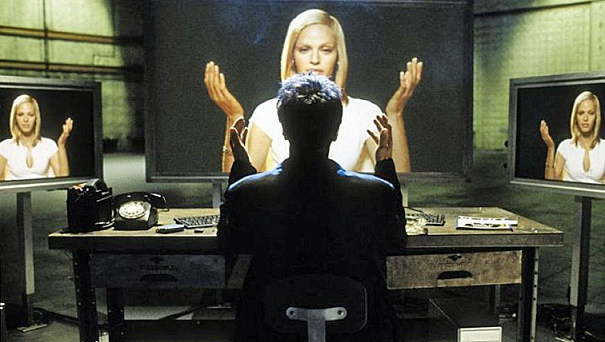
[This explains the image above, from the 2002 movie S1mOne.]

I would even now go a step further. My conviction is that 'fast turnaround production' of video fiction can be combined with the avant-garde creativity of independent filmmakers to result in something quite new and wonderful.

There will be applause both on the market square and in the castle.


Monday, September 02, 2013

Soft soap


Having been banging on here and here about new approaches to the production of serial drama, I feel I have every excuse to post the NSFW clip above from the 2006 movie Dead or Alive. Yes, Holly Valance also cut her teeth in the soap opera Neighbours, in six years appearing in 420 episodes.

Recalling the analogy I drew with the publishing industry here and the furore created by Fifty Shades of Grey, I would not hesitate to predict that eroticism will be a component of the kind of indie serial drama I see coming down the turnpike.

And did I mention smartphones for image capture? Just announced is a new model able to record 4K video!


Sunday, September 01, 2013

Empowered actors

...a follow-up to yesterday's post.


At the 2013 MacTaggart lecture at the Guardian Edinburgh International Television festival Kevin Spacey was eloquent about the future of what used to be called 'cinema' or 'television'.

"The audience have spoken. They want stories. They're dying for them. They're rooting for us to give them the right thing. And they will talk about it, binge on it, carry it with them on the bus and to the hairdresser, force it on their friends, tweet, blog, facebook, make fan pages, silly gifs and God knows what else about it. Engage with it with a passion and an intimacy that a blockbuster movie could only dream of. All we have to do is give it to them."

And is already clear that the stories the audience wants will be produced in very new ways in order to exploit the advantages of 'second screen' apps and cross-media access. 

One of the ways in which the publishing business is changing is perhaps instructive in this context. The supremacy of the established houses is being questioned by the agents whose job in the past was to be the intermediary between author and marketer of the writer's books. This gives rise to what can be termed curated self-publishing.

But it is not just in the literary arena that agencies represent creative talent... actors, too, depend on agents. And some agents will wake up quite soon the the new possibilities which they, like the writers' reps, can profit from in the new digital environment.

In many ways actors' agents have always been impresarios, intent on assembling a 'company'... a talent ensemble covering a wide range of age and type. Indeed in many cases a single agency on its own could supply the core cast for an ongoing drama series.

And today there is little to discourage a bunch of actors, encouraged by their agent, from following the suggestion Judy Garland made to Mickey Rooney in that 1939 movie... 

"Hey, let's put on a show!" 

Only the actors are going to go one step further. The next generation will have grown up shooting video on their smartphones, maybe even editing their footage with iMovie. Yes, they are acquiring basic 'production skills'! 

I see on the horizon 'up-skilled' actors, not only able to handle the almost idiot-proof cameras which can now be had, schooled in the dramaturgy of editing and as storytellers confident well beyond the 'hyphenates' (actor-directors) of the past.

The console games with which they while away the waiting time in their trailers or dressing rooms will have put them instinctively in charge of narrative and from there it is only a small step to a sufficient mastery of tomorrow's screenwriting 2.0. 

And the talent agent in all this? He or she will encourage members his ensemble to gain new skills, sell the notion to his actors. Mentor, facilitator, show-runner... but he or she had better be prepared also to act. In every sense of the word.

Saturday, August 31, 2013

The virtues of 'soap opera'

Australian actor Margot Robbie is about to hit the big time, starring in the new Richard Curtis romantic comedy, About Time. She is also soon to be seen as the leading lady, opposite Leonardo DiCaprio, in The Wolf of Wall Street  directed by Martin Scorsese.

Soap opera actors don't get enough recognition for their technical skill, she insists. "It's harder that anyone gives it credit for. A movie shoot is six months for two hours of film. We shot an episode a day. There are three cameras, booms everywhere, you have to hit your mark perfectly every time. There's no room for error. If you screw up, that's tough, it's going on air. And all people say is... 'Oh, it's just cheesy melodramatic acting'..."

Margot, twenty-three years old, reminds us of the skills she learned while working in an ongoing role for three years in the legendary Australian soap opera Neighbours.

An episode a day? Yes, if one extrapolates from the complex production logistics behind the weekly output of five episodes.

When I made the discovery that 115 minutes of narrative audio-visual fiction content could be fabricated in just a week... rather than six months... it was a revelation. More storytelling could only be better, in my view.

Even if 'soap opera', as appointment-to-view programming, will never work as well as in the past for linear broadcast channels, the production methods will, I think, be re-discovered. The conventional soaps such as those I was involved with in the nineties were wonderfully cost efficient. Multi-camera shooting and real-time editing were central to the cost savings which were possible. Today the equivalent technologies are more flexible,less cumbersome and very much cheaper.

I wonder who will make the breakthrough with episodes of serial drama shot on three high-def DSLR cameras or even next-gen iPhones?